Mold Construction
Ship of Dreams
The Double Helix was built in honor of Amanda Eid and all of those who have Rett Syndrome, to serve as a the flagship for the Great Mississippi River Race for Rett Syndrome, May 2001. The Double Helix was paddled by Clark Eid ( Amanda Eid's father, and chairman of this charity event) and Kurt Zimmermann during the race. The Double Helix was publicly placed at the world-class Morial Convention Center in New Orleans from 2006 to 2017. It was moved to a new museum on the river in Tennessee - the Tunica RiverPark & Museum - so that we can continue to raise awareness of Rett Syndrome to the general public. Final preparations are being made to extend the exhibit to other records that have been set for human-powered racing of the Mississippi RIver.
Technical Facts
Length: 25 1/2 feet, Beam: 24 inches, Maximum Height: 18 inches
Weight: 110 pounds (with dome)
Composition: More than 100 different types of wood, fiber glass, carbon fiber, epoxy and titanium
Hull Design: Nick Schade, Guillemot Kayaks
Rose Vine/DNA Design: Clark Eid, can be decoded to spell "Amanda's Dreamkeeper". Clark's daughter, Amanda, has Rett Syndrome."
Construction: Primarily Clark Eid, assistance from Nick Schade, Kurt Zimmermann and Rowland Fricke
The Double Helix was built in honor of Amanda Eid and all of those who have Rett Syndrome, to serve as a the flagship for the Great Mississippi River Race for Rett Syndrome, May 2001. The Double Helix was paddled by Clark Eid ( Amanda Eid's father, and chairman of this charity event) and Kurt Zimmermann during the race. The Double Helix was publicly placed at the world-class Morial Convention Center in New Orleans from 2006 to 2017. It was moved to a new museum on the river in Tennessee - the Tunica RiverPark & Museum - so that we can continue to raise awareness of Rett Syndrome to the general public. Final preparations are being made to extend the exhibit to other records that have been set for human-powered racing of the Mississippi RIver.
Technical Facts
Length: 25 1/2 feet, Beam: 24 inches, Maximum Height: 18 inches
Weight: 110 pounds (with dome)
Composition: More than 100 different types of wood, fiber glass, carbon fiber, epoxy and titanium
Hull Design: Nick Schade, Guillemot Kayaks
Rose Vine/DNA Design: Clark Eid, can be decoded to spell "Amanda's Dreamkeeper". Clark's daughter, Amanda, has Rett Syndrome."
Construction: Primarily Clark Eid, assistance from Nick Schade, Kurt Zimmermann and Rowland Fricke
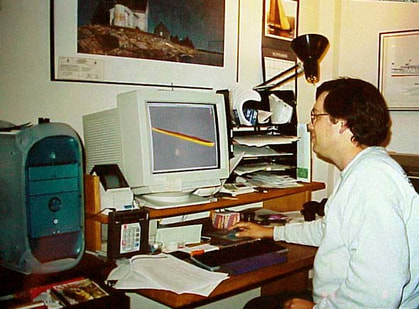
Nick Schade at the computer designing the Double Helix. A design of this type had never been done before. We had to design the hull around an average of each of the paddler's dimensions, where sitting or laying down in the forward cockpit would maintain the kayak's center of gravity. The hull was also designed for an optimal cruising speed while being just wide enough (24") to let a paddler sleep on his back.
|
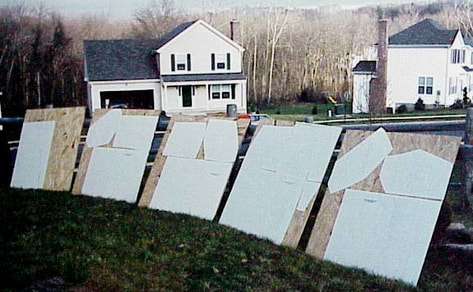
2. Blue prints of the station forms glued to plywood and ready for cutting. (Seen in the Eid's back yard.)
|
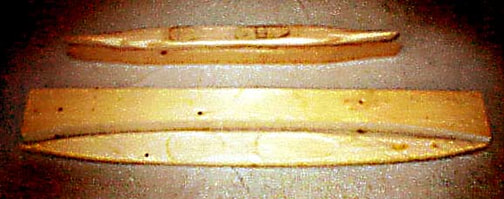
3. Clark hand carved several small models of the Double Helix to scale. These were used for logistical planning of the rose vines that would wrap the 25' hull, needing equal distance between the 60 pair of roses.
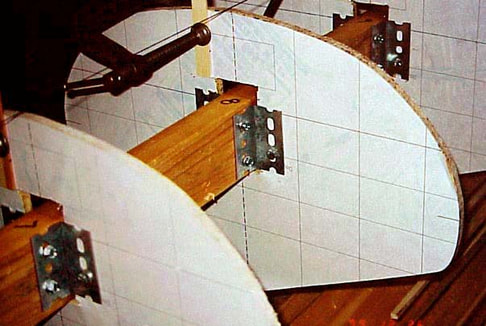
5. Clark strung the station molds along a two-by-four and held in place with brackets. The system Clark invented was unique for being able to adjust the plate in all dimensions.
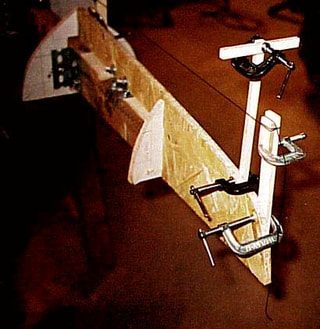
7. Correct positioning of the end forms (stern shown) was critical. Any misalignment or twist in these areas would make paddling in a straight line impossible.
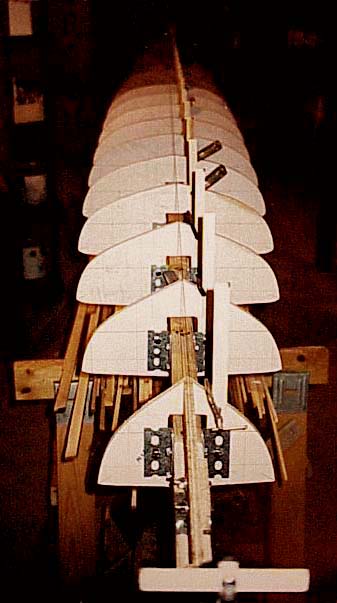
9. At last, the boat mold was ready. This kayak was built in the Eid/Potter's basement, with about 1 inch to spare getting in and out the back door after it was taken off its hinges!
|
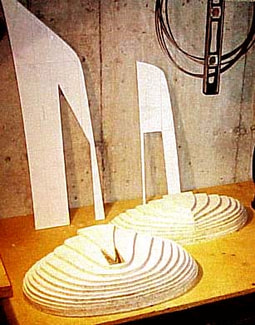
4. Clark cut the station forms - Here are the finished stack of cut station forms ready to be put together along a 2" x 4", creating the "Strong Back."
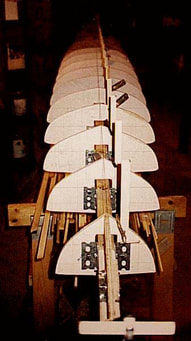
6. Great care was required to make sure all station forms were in alignment. It took 2-3 weeks for the form to stabilize with the temperature and humidity. It was adjusted daily during this period.
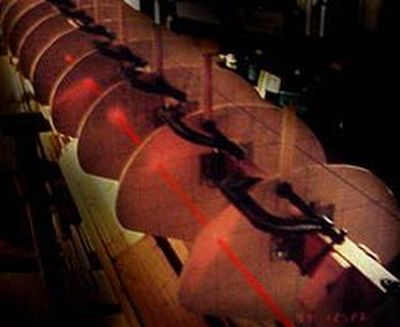
8. A laser beam was used to assist in the alignment of the station forms. This was another technique Clark invented to deal with strip-building such a long kayak.
|